26 April, 2011

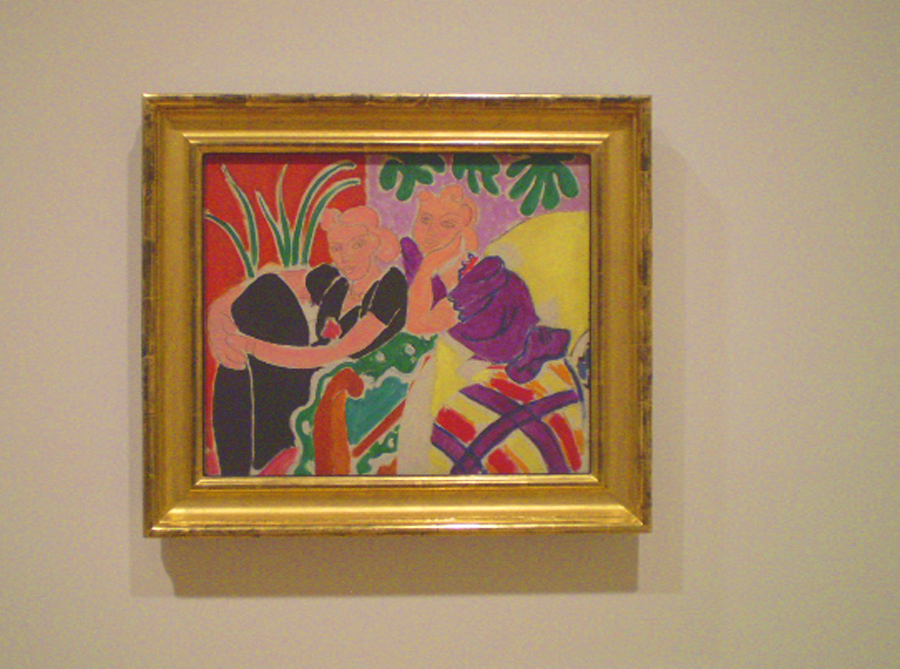
The Conversation, 1938, by Henri Matisse

San Fransisco Museum of Modern Art, SFMOMA


...balance, of purity and serenity.” 
Matisse Describing His Art.


It would be too easy to spin tales about conversations, such as the one suggested by Henri Matisse's two women in The Conversation of 1938. Instead of that, let's listen to what Matisse has really said with his Modernist masterpiece.

It is fair of the SFMOMA to use Conversation in the context of a dialog in the exhibit on the second floor, where they have set up a “conversation” between the works of different artists in their permanent collection. Compare Marcel Duchamp to Picasso and Matisse. Does Matisse speak to Mark Rothko and Jackson Pollock, two rooms away, and if so, what does he say? Consider Jasper Johns or Andy Warhol: how do they interact with the history of Modern art? Then you have the obvious question: what are these artist's saying to the viewer?


The Trajectory of a Masterwork.

Henri Matisse named two paintings The Conversation, but the 1938 piece that I saw three weeks ago in San Francisco is more than just a depiction of parlor conviviality. The Conversation, 1938, is an effortless, masterful work that is a colorist piece and is rooted in the timeless elements of painting. It also unites the qualities of drawing and painting in thoughtful ways that only Matisse could accomplish.


“Matisse was an artist in the medieval sense of the word,” said the French historian Regine Pernoud. By referencing another era, Pernoud suggests the artist's aim was over the horizon, not just his own time.  Art is the root word of both artifice and artillery. Could Henri Matisse (I am borrowing a page from his World War II era) have shot a creative shell across the ages?


My Snapshot of The Conversation, 1938
SFMOMA official image here.


Back To Basics.


By the 1930s, Matisse was leaving behind Odalesques and returning to his bold and active earlier style. The Dance, 1932-3, featured monumental figures whose energy moved outside of the confines of the mural. His illustrations for Ulysses, 1935, were 26 line images that reinvigorated Matisse's sensibilities for the drawn figure. He said, “I do not reason when I draw; I don't know where I'm going.” For Matisse, drawing was an expressionist act, and his paintings were to become infused with this element again.

Although the faces of the two women in The Conversation may have been done with a rigger brush and paint, they give one the impression of transparent paint over pencil lines. To further emphasize this effect, Matisse draws each woman's hair and face together as one area and uses the same flesh color for both elements. Matisse outlines the figures and room elements – a total departure from a painter's desire to lose edges. Instead, Matisse draws in all of the edges; sometimes with negative white lines, and at other times with pencil-thin gray lines.


The Figure, The Color and The Space.

  • The woman on your left recedes in a pure black dress, while her companion springs forward in a violet, yellow and red dress.
  • The room is an effervescent pattern of colors, with compliments of red and green, blue-green with red orange, and the triadic relationships of violet and green and then the yellow and green sofa.  
  • Both women form a triangular mass, the wall is divided vertically and there is a diagonal line created by the sofa's edge, arm and a red triangular shape at the bottom.  There is an X formed in the center of the picture by the edge of the black shirt sleeve and the elbow of the woman on your right, and the arm of the sofa.  
  • Perspective is not achieved with  lines and atmosphere, but by the relationships of colors and masses - Modern Art meets timeless divisions of the picture.
  • There is a heart shape to each face, and a heart shape can also be suggested by both faces together with the bottom being the elbow.
  • There is a a curvilinear pattern of lines and shapes around the interior of the space - they read gracefully.
  • One woman's eyes gaze to the left, and the other to the right, which adds to the expansiveness of the picture.  Dreamy and pleasant, the two are caught in a moment of happiness.


Someone has said that a painting can no more be about color than a party can be about Tupperware. Look again at Matisse and reconsider this. He uses colors as the space, suggesting both a scene and a pattern simultaneously.  The comparisons between the colors become movements, and the use of pure tones, without shading, arouse both excitement and harmony.  The feeling is one of a brightly lit midday, illuminated by the southern sun.


Do you find perfect correspondence between the nature of the drawing and the nature of the painting? In my opinion, they seem totally different from each other, absolutely contradictory. One, the drawing, depends on linear or sculptural plasticity, and the other, the painting, depends on colored plasticity.” Henri Matisse.

<><><>


Art Is Long.

Physicists think about the properties of time; they wonder if it bends or slows down under special conditions. Can fine art add anything to the conversation about time? When I am standing in front of Matisse's The Conversation, time is folded for me. This artwork may have been painted seventy-three years ago, but I am experiencing it in the here and now. If I understand the artwork, even minimally, then the artist and I are having a conversation of sorts. 

 We feel old, and somehow wizened, when we enjoy a masterwork. Henri Matisse has made what is, for me, the greatest contribution to the gallery space at the SFMOMA with The Conversation. It appears graceful and effortless in comparison to Picasso, Braque and Morandi, whose works hang in the same space. Does Marcel Duchamp, whose urinal is presented in the next room, really diminish art by his funny and outrageous installations?  His "readymade object" seems even more absurd directly after looking at Matisse's superb contribution to the canon of Modern Art. More on Duchamp in a later post.

With energy and singularity, and with clear, bright pictorial statements, Henri Matisse has given us more than words.  He has brought grace to the conversation about the art of the twentieth century.


Henri Matisse
1869-1954


The beautiful photo of the SFMOMA by cbrady2 at Photobucket.

23 April, 2011

Easter Weekend Notes

Self Portrait as The Man of Sorrows
Graphite, 1522
408 x 290 mm
Albrecht Durer


Happy Easter!  


Easter week has been a contemplative time here in my studio.  The Matisse series has been, for me, a great exercise in writing and critique, and my essay on The Conversation will be published here at The Colorist after the holiday.  


As if I needed more things to take my mind off of the highest Christian holiday, and off of my painting, life rolls in and washes my time away.  Doctors appointments, turkey season, spring yard work, and my new iPhone, which Lorie gave me last night.  Still, in all, I did make time for two plein air pieces, which I hope to post here or at Pastel in the next couple of days.  


It was fun to find a new store, yesterday, in Spokane Valley named the Hobby Lobby.  It is like a cavernous Michaels, only cheaper.  I bought a few General pencils, a drawing board of Chinese make (I need drawing boards loaded with current projects and more of them than you'd think) and the best things were small Birch wood boxes and trays.  I currently keep my smallest pastel outdoor set in a cigar box that is tiny, but now have an even smaller one than that.  It makes me want to make some of my own boxes, but that urge will pass, I'm sure.


I am very happy to see Diane Mize posting at COMPOSE again.  Harry Bell has been blogging for 7 years.  Yes, you read that right: seven years.  His cityscapes are a lesson in composition in themselves.

More Notes:

Lots of big images by Durer - very nice collection.


18 April, 2011

No Pressure


My essay on Henri Matisse's painting, The Conversation, 1938, will be, as far as I can tell, the only available essay on this work.  But, no pressure.

14 April, 2011

1938 Would Kill a Normal Man, But Not Henri Matisse.

@@@


Hitler in Italy, The Year 1938


Don't confuse The Conversation of 1938 with Henri Matisse's painting of the same title completed in 1912.


In 1938, Henri Matisse's world was coming undone.  The days, metaphorically speaking, were dark. French Prime Minister, Édouard Daladier, and British PM Neville Chamberlain, worked in vain to avoid war with Germany and Italy.  1938 was the year of the Austrian Anschluss and the annexation of the Sudetenland. Hitler would pay a high profile visit to Rome and Florence in May.  Ominously, the Nazis began the construction of the large concentration camp in Mauthausen, Austria. In Pablo Picasso's Spain, the Civil War was raging. In Nice, where Matisse lived, residents feared an Italian invasion.


Henri Matisse had twice experienced the occupation of his hometown of Bohain, France by the German army.  Now, he feared the third such event.  At the age of sixty-nine, his health was fragile and in another couple of years he would undergo a colostomy, which bound him to a wheelchair and eventually to his bed.  Although Matisse would live another sixteen years, in 1938 his life as a painter was soon to end.


Amelie, his wife of forty years, was beginning the process of separation from Matisse and would sue in less than a year.  She had endured the hat painting, but was finished with the famous painter as a wife. Turmoil is not the right word to describe M. Matisse's life - cataclysmic would do better.


What will Henri do with this chaotic milieu?  He will paint what is, in my estimation, the best work hanging in the San Fransisco Museum of Modern Art. See my report next time.


Amelie Matisse, giving "The Look."
It's not about the hat.

13 April, 2011

Entr'acte

<><><>


"Exactitude is Not Truth," 
Henri Matisse.


Please enjoy some Debussy while I am writing my essay on The Conversation, 1938, Matisse.

10 April, 2011

Goodbye, Hedda


Artist Hedda Sterne passed away last week at the age of 100.


She was the one woman in that famous photograph of "The Irascibles," taken in New York in 1950.  Remember her, standing on the table (not a chair) in the back of the room? That was the coming of age year for American artists.


Goodbye, Hedda.  You were one lady who stood tall.


"Nobody tried to influence me, I just worked."  Quote HS.


Notes:


I found out through Debu Barve.
Hedda Sterne: The last of ‘The Irascibles.’

ArtDaily.

The Wikipedia article on HS is a good one.


Blogger input. Nancy Natale.


TNYRB, Sarah Boxer.


Photo: Phtotbucket/themissinggrib.

09 April, 2011

Color Understory


Tangled Color
7.4" x 12"
Pastel & Charcoal
Casey Klahn

I found this image in my files, which has not been posted in this format before.  This painting hangs next to my desk in the house.


Next time:  More Matisse at the SFMOMA.  Previous posts on SFMOMA herehere and here.

08 April, 2011

Have a Dish of Modern Art

Come with me, dear reader, on a walking tour of the San Fransisco Museum of Modern Art.  I'll be focused on the older holdings, since those are the artworks that have been subjected to the acid test of time. First, may I present my card?


Don't be fooled.  I will be praising here as much as criticizing, because I am an adherent of Modern Art.  But, it helps to have a healthy handful of skepticism when you are viewing the Moderns.  I don't let their notoriety get in the way of my having a go at the master artists' works.

The Tour.

The SFMOMA introduces their permanent collection exhibition with the Fauvists and Cubists who painted at the beginning of the Twentieth Century.  Matisse's be-hatted wife,  Amélie Parayre, invites you to enter. The layout of the second floor  weaves around different rooms, establishing a timeline of Modern works and telling the story of progressive ideas in art.

The first room gives way to anti-art statements by Marcel Duchamp, and an eddy-out shows off the museums proud holdings by Paul Klee.  I was attracted to the next room from an historical sense, if not as much for the art.  These were the large format Diego Rivera and Frida Kahlo paintings. Next are the mid-century rooms, where the larger-than-life heroes are presented, such as Mark Rothko and many, but not by any stretch most, of the Abstract Expressionists.  This was my favorite room, after the early Modernists.  More details on that later.

As you leave the rare air of Abstract Expressionism, and continue to the next rooms, you may become, as I was, lost at the soul-level.  Not for ignorance was I lost.  I am well aware of the movement to supersede painting with objects and experiences.  In these rooms you find the advancement of Pop Art, and the experiences of video and installations.  Thus begins the boredom.  That's me.  I love painting and sculpture, and don't feel the need to replace them in the Post-Modern sense.

Opinions.

Pride of place at the SFMOMA is given to Woman With A Hat, by Henri Matisse.  Even now, one-hundred and six years after completion, this painting appears different from anything else ever painted, except maybe by Matisse, himself.


Because this was my first opportunity to view a painting by Matisse, I spent a lot of time with Woman With A Hat, 1905.  I have been under Matisse's influence fairly heavily for the past year, having read the massive two-volume biography by Hilary Spurling, as well as a couple of lesser volumes on this master.  It is easy to see why HM is noted as an early, major influence on Modern Art.

Matisse is much better than I thought he was from even the glowing books and articles I have read.  This is a good example of how actual real life viewing is superior to the printed page or the CRT.  In those, I have to say I desired something else out of the man.  I wanted flow.  I wanted skill and expression.  

In the three Matisse paintings that the SFMOMA has on view, I found my wishes fulfilled.  Well, maybe more so in two of them, because the one still life looked just plain wrong to me.  It was forced, and especially it suffered from being hung next to a Morandi.  But The Conversation and the Woman With A Hat were outstanding paintings.

Woman With A Hat presents a mix of skilled brushwork, and savage beastly work as well.  Matisse flattens, pops, effuses and describes all at the same time, and he never does it meanly or without intention.  You get the tension between the flattering and the fatuous; the intimacy and the utility; the fine and the fierce.

I began to see a color that I have only been aware of in a minor way before.  It is the canvas color of old egg-white, with blushes of pale yellow and pink in this particular case.  This comes in better focus when we look at Joan Mitchell and some other works later on.

If you look closely at Edgar Degas' work of the same era, you see greens, blues and other wildly non-objective colors on the faces of his women.  But, Matisse is presenting the colorist view here, which is that the colors, along with the forms, are central to the ideas presented.  Not just as colors, or as not-true colors, but in the role of exposing new ways of seeing a painting.  Paintings are flat artifices, revealing other things about our world than rote description.  Their beauty is a transformational value; they are a tool for change and progress.  Amelie is beautiful in ways not under the tyranny of the caliper and the ruler.

Maurice Denis wrote that Woman With A Hat embodies "des noumènes de tableaux," which can be translated as the pure reason of ideas in the picture.  If so, it was a breakthrough of painting from abstract ideas; from instinct. It raised the bar.

I could go on.  I love The Conversation, 1938, Matisse, even more.  It is the greatest representational painting on view in the museum in my estimation, and it hangs in a room with Picasso, Morandi and Braque.  More on that next time.

Woman With A Hat
o/c, 1905
31.75" x 23.5"
Henri Matisse

Notes.

  1. Woman With A Hat.
  2. "Genuine points of comparison for Woman with a Hat are few." T.J. Clark.  In depth essay on Matisse's painting.


06 April, 2011

San Fransisco Museum of Modern Art

<><><>


The least perceptible movement of air pushed against my face, and my eyes opened slowly. This was warm, moist air from the Pacific; the kind of air that San Fransisco is famous for.  I had taken the red eye to California that morning, sped to the art museum, and spent the morning absorbing notable works of Modern art.  I was tired enough when I sat down at the rooftop cafe, that I thought I was sitting next to a large, closed window overlooking the atrium sculpture garden.  


I sipped tea with cream and sugar, and rested my eyes.  What I thought was a big window was actually an open door and I was literally at the threshold.  By analogy, perhaps it was the threshold of springtime, this being the first good weather I've experienced this year.  It was a pleasant unwinding.  My first trip to a museum after the long winter, cooped up in my stuffy and busy studio in eastern Washington.


Since my business in California was to judge some art, I used the SFMOMA as a sort of warm-up for my critical mindset.  What would it be like for me to be a first-time jurist for an art event?  It is especially hard to come off the farm (literally - my studio is on our farmstead) and engage with other people's artwork.


Let me tell you, kind reader, it was plenty fun to tear into the biggies enshrined at the Museum of Modern Art.  It was only practice, and the shoulders of these giants are plenty big enough to tolerate my arrows.  And, I did sling a few.  Return here next time, and we'll dish the greats with some relish and some salt.


The San Fransisco SFMOMA is nothing, if not convenient.  Me in front of a well known Marcel Duchamp object.  

31 March, 2011

How Do You Like My Hat?

La femme au chapeau
o/c, 79.4 x 59.7 cm
Henri Matisse
SFMOMA


In the next few days I'll be posting about my trip to the SFMOMA this week.  Matisse, Rothko and Joan Mitchell were the standouts.


Audio Commentary.

27 March, 2011

Captain America Couldn't Get In The Tenth Division


<><><>

Since I have a happy large bumpsworth of readers coming in from the military veteran site, Blackfive, I want to write a little about some drawings I did, WWII, my father's service and also share some gratuitous climbing stories.  Pull up a chair.


Personal story.


One time I was rock climbing in the Cascade Mountains with another fellow, and I mentioned my father's having been in the 10th Mountain Division.  He said that his own father wanted very badly to get in the Tenth, but was underage.  That guy's father went on to become one of the most esteemed mountain climbers of all time, which was probably some consolation to him.  Anyway, we did some gnarly climbs, and started singing climbing and Tenth Mountain songs at the top of our voices.  It was fun.


Captain America Couldn't Get In The Tenth Division.


My father had similar experiences.  He'd be at the VFW and some guy would be at the bar asking where he served.  When dad told, the answer invariably went something like, "no kiddin'?  I tried to get in that unit!"


Service in the World War II 10th Mountain Division was a rare and unique privilege.  Some men volunteered for special units, and then had to qualify for their billet, and we think of paratroopers, fliers, and Marine Raiders when we think of elite troops in the war.  But, in the Tenth, an applicant had to present qualifications as a mountaineer, skier or some type of rugged outdoorsman, such as a wrangler, cowboy or mule skinner.  As proof, you had to carry three letters of recommendation from some authority on the matter.  Then, after being successfully boarded, you were privileged to train with the nation's only ski troops and mountain infantry, and to say it was rugged is comically understated.


Anyway, the short version is that my dad's unit was the hardest trained unit of Americans in the Second World War.  This explains some of the reason for their outstanding performance in combat on the Italian Front.  I visited the battlefields in 2006, and the reception the veterans received there from the Italians was remarkable.


I had the privilege of drawing some designs and images for a war monument, and the story is told in the following re-post.


Climber Sketch.


Sketch WW II Climber
11" x 9"
Charcoal, Pastel and Compressed White Charcoal on Rives BFK
Casey Klahn


Yesterday's post on the Medal of Honor.

I am proposing an illustration for a memorial to my late father's World War Two army division. I will post the roughs and sketches here as I get them completed.

This guy has a ways to go as a sketch, but he's on the path. I want to re-render the hand, and maybe add some more grace of movement. That used to be a big deal for me in the days when I drew the figure lots, and it has extra meaning when rock climbing is involved. I did enjoy taking the extra effort to model the figure, especially since it will stick out (if this becomes the final image) from a marble flat as an etching.

Next, I want to render a ski trooper as another proposal for the etching.

For you oldsters out there: remember Tom Lea? I certainly thought of his seminal on-sight drawings from WW II. Must have rubbed off on my psyche.

This book, The Two Thousand Yard Stare, covers Lea's WW II art and writings about his work. I once asked my late father, who saw heavy combat in North Italy, about this phenomenon of the "two thousand yard stare," which is the look a shell-shocked infantryman "gets" when he comes off the line. His story was a keeper. He said that he recalled one guy in particular who had that look coming off the front in the North Apennines (revered as one of the worst places to be in WW II) and he was also rather tall. Maybe 6' 6" or something like that.  Years after the war, my dad picked him out of a crowd back in the states - quite an unusual circumstance, but he certainly remembered that guy's face.

I spent a number of years in the infantry, and later as a mountain climber. All subjects deeply held, and good content for my illustrations.


They Drew Fire. PBS documentary on war artists of WW II.
Tenth Mountain Division Association. My father's army unit. I am working up illustrations for a 
memorial plaque in their honor.


Photo credit: Lorie Klahn

Finger Crack,
Leavenworth, Washington


25 March, 2011

Tangle

Barn Tangle
Pastel & Charcoal
7" x 9.2"
Casey Klahn

This is right about the time I'd like to get out in the back yard and paint some more of these scenes around the house.  If the weather would just offer something other than the rain and snow mix it's giving today, I could make good on that goal. Anytime, now, Mr. Weatherman...


This barn image is from last year.

24 March, 2011

What Degas Said

Dancer
Edgar Degas


Edgar Degas weighed in on the artist's ambiguity.  The irony is that he is a consummate realist, and on the short list of historic master draftsmen.  Yet, here is the great man's admission that art is too big for him to define in simple terms.  


"I have spent all my life trying to figure out what art is all about.  If I knew, I should have done something about it long ago."  Degas.

21 March, 2011

Quotes About Ambiguity In Art

The Red Madras Headress
1907, O/C
99.4 x 80.5 cm
Henri Matisse
Barnes Foundation, Merion, PA 


Looking for an anchor to tie your art to?  You won't find it here, partner.  Instead, I bring you ambiguity. 


Artist's Quotes


"There is in every artist’s studio a scrap heap of discarded works in which the artist’s discipline prevailed against his imagination." Robert Brault.

"To sum up, I work without a theory. I am conscious above all of the forces involved, and find myself driven forward by an idea that I can really only grasp bit by bit as it grows with the picture." Henri Matisse.

"I paint in order not to cry." Paul Klee.

"But the Devil whoops, as he whooped of old: 'It's clever, but is it Art?'" Rudyard Kipling.

"No great art has ever been made without the artist having known danger." Rainer Maria Rilke.

"Whoever wishes to devote himself to painting should begin by cutting out his own tongue." Henri Matisse.

"Not only do I not know what's going on, I wouldn't know what to do about it if I did."  George Carlin.

"What garlic is to salad, insanity is to art." Augustus Saint-Gaudens.

"An artist's career always begins tomorrow."  James McNeill Whistler.

"One must beware of a formula good for everything, that will serve to interpret the other arts as well as reality, and that instead of creating will only produce a style, or rather a stylization." George Braque.

"If I knew what I was doing, I'd be doing it right now." Keith Urban.

"Truth and reality in art do not arise until you no longer understand what you are doing and are capable of, but nevertheless sense a power that grows in proportion to your resistance." Henri Matisse.

***

Please accept the following document, which is a copy of these quotes on ambiguity, as a gift from me.  Right click to open the image in a new folder, and then save and print.


17 March, 2011

Matisse and Respect

Sometimes Weather
9" x 7"
Pastel
Casey Klahn


"Matisse respected nobody and nothing,"  Maurice Boudot-Lamotte.


More at The Colorist on Matisse.

14 March, 2011

Why Write?


"Artspeak" is a bewildering mess of verbiage and mental calisthenics.  Kathy Cartwright asks: why write essays about art at all?   It's good to think about why we write. Someone once said that if you don't state your artistic direction then others will do it for you.  That's why I like to write about art and my own direction.  


One reward for writing about art is that on occasion you get some recognition.  Over the weekend, ArtSlant posted my article on Matisse on their Facebook page.


I think that someone who spoke about one's art direction was Alyson B. Stanfield.

12 March, 2011

Boulder


Erratic Boulder
6.25" x 8.5"
Pastel & Charcoal
Casey Klahn 


We had snow a couple times this week. Maybe when spring gets here, I'll think about doing some more of these boulder scenes.


Another note.

I grew up around the Pacific beaches. I recall, as a kid, my uncle driving onto the bridge in his pick-up truck and the span had been washed away by a tidal wave (old term).  He broke his arm, and us youngsters got a kick out of seeing that old bridge down in the water like that.  I also felt a 6.5 earthquake, and that is the extent of my experiences with natural disasters, since I completely missed any volcanic fallout when that big one went off in 1980. 

Also, I have been to Japan, which is a beautiful and serene country. Not unlike the boulder in this painting, solid and solitary in her beauty.  

We are watching Internet news and videos of the unimaginable situation across the ocean in Japan. My prayers and thoughts go out to the many who are affected by this natural disaster.


08 March, 2011

Kids Those Days

Our friend Adam Cope reminds us why drawing and painting one's children is something artists are fond of doing.  In a very well blogged report, he takes us through a chef's tour of some tender and poignant children's portraits.


I was happy to find his link to a blog titled ArtKids, Artistic depictions of children.


Rembrandt 


I remember best the one by Rembrandt that is a sanguine chalk sketch of two matrons and a toddler.  It's in the gaze of the child that this one comes alive.


Let me add these two reactions I had to this subject.  


Last night I watched an interview by Charlie Rose detailing an exhibition of Henri Matisse works, and one of the major works is this one of Pierre Matisse taking his piano lessons.  It has layers and layers of meaning, and I always enjoy studying this painting, which has to do with the First World War. It is interesting to note that Pierre is depicted as an adolescent, but when Matisse painted this, his son was serving as a soldier.


You know when you go to a Charlie Rose interview, you will be tied up for an hour, so be forewarned.


Secondly, I want you to see the work of Antti Rautiola, of Finland, whose subjects are children.


04 March, 2011

Studio News - Winter 2010-2011


Studio News - Winter 2010-2011
Casey Klahn


1. There are over fifty new artworks in my two flat file cabinets, waiting for the framer. I don't actually expect all fifty to make the final cut - what I do is eliminate the worst third or more after I get a better look at them (and come to my senses). This process I wrote about previously: The Axe Falleth


These artworks are also waiting for the formal photographs, and then they go to the Photoshop technician and the archiver. We now have the latest Photoshop program in the house, but I think I'll stick with my old version 1-point-oh. I mean, if it was good enough for Fred Flintstone, then it's good enough for me. 


2. The direction of my art is evolving. I am trying to simplify my colors. That means that I am developing smaller ideas, or maybe I want to say more singular ideas. 


Subjects are the prairie, especially the trees and up the hill, and the Hoquiam River. Also, I am going bigger. I continue to struggle with doing full sheet work, but I am creating many pastel paintings that are in the almost full sheet sizes. Is it the opening dimensions that I struggle with? Possibly. I typically do not compose well with traditional opening sizes, but am prone to work in "custom" sizes. It has to do with my way of composing images - from the inside out. By the same token, I do respond very well to the Golden Rectangle - which is, again, not a standard opening size. I drive my framer nuts.


3. I have been cleaning, organizing and doing minor changes in my studio. The biggest addition is the sheet rock wall, where I have a nice, white wall space that is well lit.  Visitors are expected, and studio sales may become a major part of my vocation in years to come. 


I also installed another track light bar. The biggest challenge has been having too much light from snow reflection. Even pulling the blinds was not enough. I finally hung a blanket over my north windows to cut the harsh light. 


A new microwave oven keeps me in the studio for lunch, which gives me more time for art making.


Did you see Cindy Michaud's new modular custom studio space? It is well thought out and worth your look: New Studio Reveal


4. It has been record-cold around here. My studio is nice and warm, except when the wind hits my east or north windows. They may be insulated windows, but there are gaps opened up by the loss of squareness that comes from moving a trailer once or twice. Also, the front door, which opens into my studio, has lost it's weather stripping and I haven't replaced it - as simple as that would be. Good thing there is always Duct tape.


4. This blog continues to be a popular place for readers to find out what goofy ideas are in my head about art and I guess they come here looking for what art I am doing lately. I always say the pictures are coming, and then I post old images that I have on file. New readers like to see these, and maybe my old readers have missed one or two. 


5. On a personal front, I just finished reading a private, unbound  memoir of an American who spent the Second World War as a POW in Japan and The Philippines.  He was an army officer who survived the horrific Bataan Death March and was imprisoned in 5 camps altogether.  His humility and courage is typical of his generation, and it must be said, atypical of people in general.  


6.  If you are someone who comments here often, and yet don't find your blog on my text blog roll, send me a note so I can fix that.  I am not as attentive to that as I should be.  I just found one that made me say, "Doh! How could I not have her on my blog roll?"


River Corner, Red
3.5" x 3.75"
Pastel
Casey Klahn


My wonderful daughter turns 8 on Monday.  

Photo Credits:  Lorie Klahn
Abstract Expressionism, Art Criticism, Artists, Colorist Art, Drawing, History, Impressionism, Modern Art, Painting, Pastel, Post Impressionism