21 May, 2014

20 May, 2014

Was? Where? What? Is?

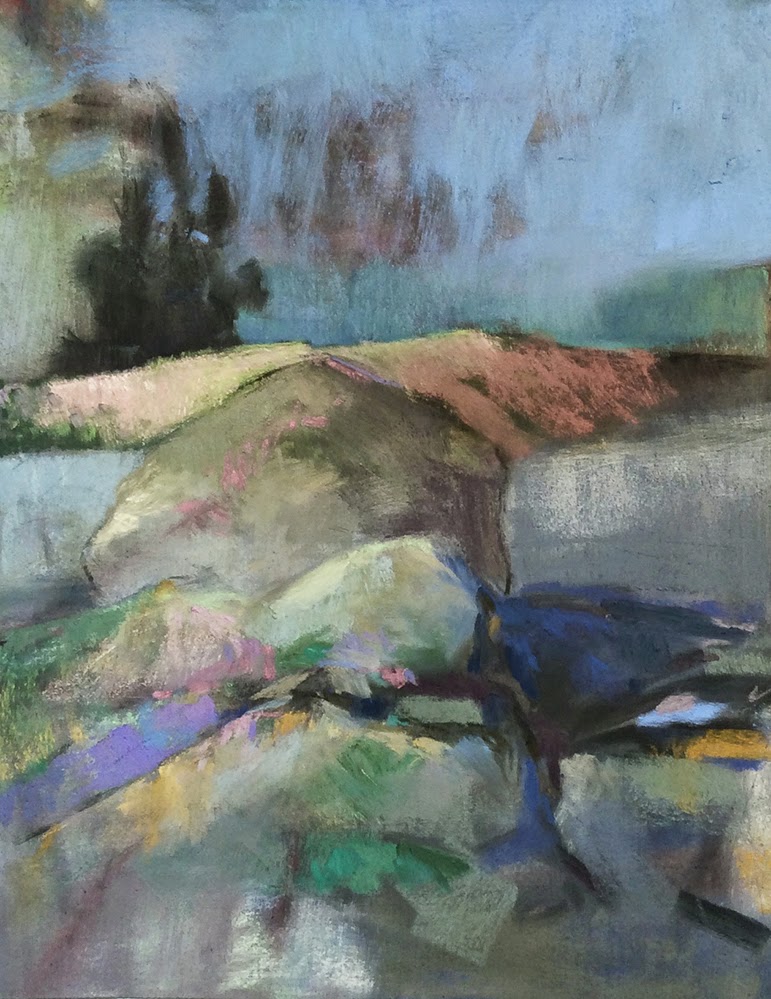
Was This Where? 2014
13.75" x 11"
Pastel
Casey Klahn


I am asking questions visually. Was this where you were? Is it new? Is the scenery changing?

Here is Bob Dylan, asking questions musically:


18 May, 2014

Wolf Kahn Obligations


Bravo, Mr. Kahn. I couldn't agree with you more about having a sense of obligation to our culture. Our better angels thank you.

17 May, 2014

Rocks and Rivers

Climber's River, 2014
9" x 12"
Pastel
Casey Klahn


It's fun to render rocks. This boulders and river scene is reminiscent of my rock climbing days and visits to Icicle Creek, in Washington. Maybe I'll get there this summer and do some more scenes.

09 May, 2014

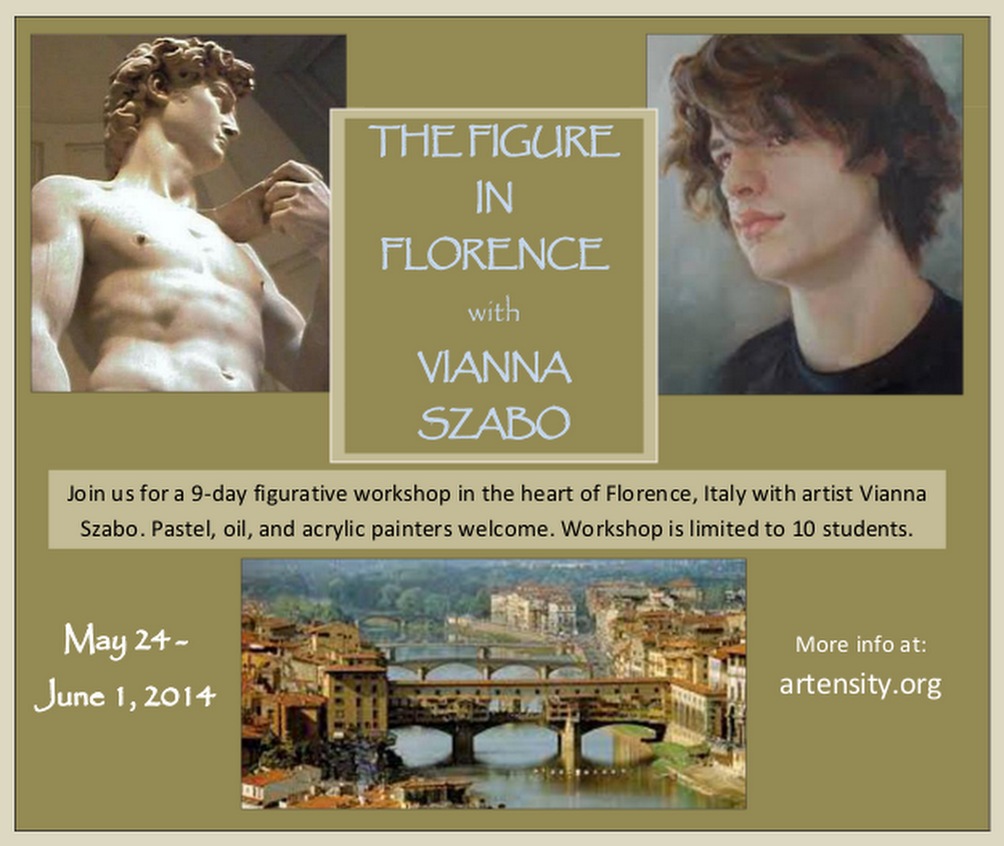
Florence with Vianna Szabo


Vianna Szabo

Is Italy in your very near future? I want to bring Vianna's incredible workshop to your attention. It is at the end of May and is your opportunity to paint the figure in Florence. The hosts are native to the Florence region, and plan exciting art events to coincide with this 9-day figure/portrait workshop. 

When you get back, tell me how everything goes. I plan to teach in the same venue in the next year or two!


08 May, 2014

IAPS TWENTY-FOURTH JURIED EXHIBITION in Boston


Shades Grand River, Canada
14.5" x 18.5."
Pastel
Casey Klahn

Thanks to Liz Haywood-Sullivan and the IAPS organization for exhibiting this pastel in Boston, May 10-June 21, 2014.  Liz writes the following:

"Please Come to Boston in the Springtime" - Dave Loggins.

If you do be sure to see the 24th IAPS Juried Exhibition at Vose Galleries. The exhibition runs from May 10 through June 21. Vose Galleries has devoted all 5 floors to pastel! The two lower floors display over 30 antique pastels in a show called "Crystals of Pigment: the Power of Pastel, and the top three floors exhibit the 76 paintings from around the world that make up the IAPS exhibition. This is a must see show!


Vose Gallery


Thanks also to Claudia Seymour and Margaret Dyer, jurists.


29 April, 2014

26 April, 2014

Blue Era

A Blue Room in the Forest. 2014.
@ 10" x 13"
Pastel
Casey Klahn


I love seeing young musicians doing well and being hip. Enjoy this live ensemble performing Erik Satie's Gn no.1.

Erik Satie - Gnossienne No.1 - Seth Ford-Young

25 April, 2014

Entr'acte Friday


Blue Cloud Sky. 2104
@8" x 12" 
Pastel 
Casey Klahn


Pianist: 
Alessio Nanni

24 April, 2014

Blue Certainty


"A certain blue enters your soul...a new era is coming. " Henri Matisse. 1952.


From the Tate:
A giant of modern art, this landmark show explores the final chapter in Matisse’s career as he began ‘carving into colour’ and his series of spectacular cut-outs was born.


Cinema event in the UK. 


23 April, 2014

Matisse - Video Support

Henri Matisse's groundbreaking cut-outs were rendered in the last decade of his life, from about 1943 in Nazi-occupied France, till about 1953, when Snail was completed, and are in London now and will be in New York in October. My post from yesterday regarding the exhibit.

One of the enjoyable aspects of this exhibit is the film support that illuminates the story of Matisse's process in making these great collages. Posted today: Alastair Sooke and A Cut Above the Rest.


Study notes for Henri Matisse.

<><><>

13 April, 2014

Nobody Was Harmed In The Making Of This Artwork


Hanging Tree in Color
@7" x 15"
Pastel
Casey Klahn


How many people consider nostalgia to be the pinnacle of art?  An astounding number in your circle, no doubt, see the number one function of paintings and drawings to be taking them back to a bygone era. The Victorian era, perhaps. Roaring Twenties, anyone? 

Once upon a time, I showed a drawing of a tree that I had just rendered to this man I barely knew. He thought to compliment me by suggesting that there, on the branch, I ought to place a man hanging. That would amp the emotional appeal, I suppose. 

That is precisely what practitioners of fine art are supposed to avoid: the appeal to sympathy or nostalgia. The reason is that it is an attempt to recruit the viewer based on an appeal to his feelings about something. How in Bloody Sunday am I supposed to guess people's feelings? Is it wisest for the artist to take a pole of the relatively specific feelings of the greatest majority of rubes who might wander past his artwork as it hangs, in perpetuity, seeking those whom it will conquer? 

It's a rather progressive approach to marketing art, and altogether wrongheaded for lots of reasons.  The most important reason it is wrong is that contemporary art should be my soapbox - my ideas. Not Aunt Sweeney's, and not Joe Q. Public's sympathies. My ideas are universal enough to appeal and conquer plenty fine, thank you. 

No criminal needs to hang in a tree for the advancement of my art today. Live and let live, I say.  

01 April, 2014

Italy!

Riva Sole Reviso
8" x 9.75"
Pastel
Casey Klahn


In 2015 I will be going to Italy to teach a 14-day workshop at La Romita.  I first heard about this wonderful art workshop center from a local artist and friend. La Romita was established in 1548 as a monastery. Workshops are housed and catered on site, and logistics for painting forays are supported by the staff.

Here is a blurb from their website:

La Romita School of Art first opened in 1966, under the guidance of Enza Quargnali, as the summer art program of Rockford College in Illinois. For over 50 years people have stayed at La Romita, painting the landscape, people, and towns in the beautiful Umbrian hill country, whose radiant golden light has charmed artists since the days of Perugino and his famous pupil, Rafael.


La Romita.

I am gathering interest for October or July, 2015. Contact me.

30 March, 2014

March 30 is Vincent van Gogh's Birthday


The Vincent & Theo van Gogh Graves


Vincent was denied a church funeral because of his suicide. Those were the days when it was considered a sin. VVG had plenty of that. Sin. His mother wished him dead well before his actual demise, and his father disowned him.

In the list of shared background that I have with VVG, there is the matter that I have my BA in the Bible and theology. One of the things in the van Gogh story that has been bugging me is the art critics who write the histories of the old boy have him renouncing his Christian faith. I find no evidence of that. Yes, he most definitely strayed "off the reservation", and had unkind things to say about the church. He cohabits with, and consorts with, prostitutes. Then again, Hosea the prophet (remember, he has a whole book of the Bible) was married to one of those.

But I see no renunciation of Christ. In fact, I see evidence to the contrary. Unlike myself, Vincent was a Calvinist. Strictly speaking, these guys think that one is "Once Saved, Always Saved". Which means, once you have been compelled, via Holy Election, to accept Christ, you will not stray, in spite of any evidence to the contrary. For you non-theologically minded, let's put it this way: if you were VG's father, a Calvinist minister, you would believe in the secure salvation of Vincent, no matter what he did after accepting Christ.

His parent's ungracious behavior towards him was understandable, in sociological terms. The first people you lose when you leave behind your sanity are your family. Turns out, more tragically, that many of Vincent's immediate family had dementia in their final days, due to the ravages of syphilis.

Of course, van Gogh is a father of Modernism. Yes, he exalted self, art, and nature. Certainly these things may crowd out the heart's room for God. I see nothing in that, however, to irrevocably overcome his place in the eternal. God knows, not I.

For the irreligious this may be a painful and seemingly unnecessary post. But I don't know how, without bald redaction, one can study the artist van Gogh without his faith, or art history (western) without Christ. It would seem to be impossible.
Certainly, it needs to be said, that the trend among VG's historians to strip him of his salvation is probably ill-informed, at best. I don't think I would be too surprised, standing on the other side, that I should meet the great artist, Vincent van Gogh.

It appears that others have covered this same ground, and agree with my thesis.
See:
This article by Cliff Edwards on VG's faith.

Also: (In both articles the errors are left as is)
"Few images in modern art have so captured the attention of the public as Van Gogh's Starry Night, a painting that reveals all the light and glory hidden in an ordinary evening sky. In this very readable study of Van Gogh, essentially a spiritual biography, Kathleen Erickson explores the intense spirituality of the painter, from his early religious training and evangelical missionary work to the crisis that occurred when the church rejected his more radical way of following Christ. Erickson argues (against many Van Gogh scholars) that the artist's mature work reflects not a rejection of Christ so much as a rejection of a dogmatic church, seeing instead in the famous images of his art a profound connection to Christian symbols. Throughout, she helps us to discover the source of the power in Van Gogh's stars and sunflowers." --Doug Thorpe in this review of At Eternity's Gate: The Spiritual Vision of Vincent van Gogh.

From Publisher's Weekly:
"Erickson's account of the spiritual dimensions of van Gogh's work is an important corrective to two widespread assumptions: first, that his background was theologically Calvinist; second, that he abandoned religion when he began his professional career as an artist. Drawing extensively on van Gogh's correspondence, Erickson argues convincingly that the so-called Groningen school?(sic) more Arminian than Calvinist?was the foundation for van Gogh's religious outlook and that his abandonment of institutional Christianity (precipitated by disillusionment with his uncle and theological mentor, Johannes Paulus Stricker) was not so much an abandonment of religion as a move to synthesize Christianity and modernity via mysticism. Her discussion of van Gogh's late work is particularly compelling in this regard. Erickson's diagnostic discussion of van Gogh's mental illness is intriguing, though such extended discussion of whether he was epileptic, bipolar, schizophrenic or a combination is more of a distraction than a contribution to artistic or religious appreciation of his work. This work is a lucid and accessible contribution to understanding the religious character of van Gogh's artistic vision."
Copyright 1998 Reed Business Information, Inc. (Pasted from Amazon)

I won't argue the Arminian vs. Calvinist parts, here.

This post was first published in 2007.


Abstract Expressionism, Art Criticism, Artists, Colorist Art, Drawing, History, Impressionism, Modern Art, Painting, Pastel, Post Impressionism