31 October, 2008

Generosity

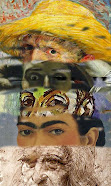
Self Portrait Dedicated to Paul Gauguin
o/c, 1888
van Gogh


Early in my career as an artist I was advised to
never give away my art. The idea is to establish your value, and often people who get something for nothing hold that something to its ticket price.

Maybe one model for the uncertain economic times we are living in will be for the (established) artist to now, sometimes, gift his art. The goodwill can't hurt, and there is that old word: exposure. My own path has been to donate at least one work per year to organizations.

An artist can also give time, expertise and labor.

One of the great examples of generosity in art history can be found in the life of Vincent van Gogh. He loved humankind, and really created his inimitable body of works for our enjoyment.

Here are musicians Chet Atkins and Don McLain performing Vincent, which is about VVG's unselfish love. Find the words to the song here.

The youth here may not remember this song, but those of us in the 50 plus category will now go for a tissue...


“I feel that there is nothing more truly artistic than to love people,” Vincent van Gogh.

29 October, 2008

Excellence

Bouldering at Joshua Tree
Photo Credit: Lorie Klahn

There has been a strong case put forth against excellence in art. The whole Postmodern Art movement declares that "dominant paradigms" need upturning, like beauty and skill.

My contemporary hero, Wolf Kahn, wrote that he regrets his latter-day skills in technique, because formerly, without his expertise as an oil painter, he was freer to "overwork" his images. Our current subject, Henri Matisse, worked years to undo his formal art training in order to create his Modern Art statement of pure, "over-wrought" and sensational color.

Because of Wolf Kahn's influence, I frequently take a pastel work and bring it well past any coherent finished point. I literally ruin the artwork, over-filling the tooth of the paper and muddying the colors. In the process, many wonderful discoveries occur! New color combinations and compositions come about. New possibilities with the medium are revealed.

In the dock for excellence, one can argue that the very definition of the word "artist" includes the idea of skill. And as my prime exhibit, I refer you to the high quality of current art. Evidence of Postmodernism's faults is everywhere present.

How to reconcile my personal beliefs about rudimentary values in art versus excellent technique? Maybe there doesn't need to be a reconciliation when one considers that there is a continuity to the artist's progress from his early to his late works. The unity of an artist's corpus is undeniable in the fact that both his early works and his later works are created by the same hand.

I feel that many more paintings await me with greater powers as a pastelist. I'll be thinking about the finer use of my medium as my studio life progresses this year.

27 October, 2008

Decisiveness - Drawing the Line

Kanji Writing
15.5" x 9"
Pastel
Casey Klahn


In the post, Characteristics & Goals, we began a path of exploring some traits that it would behoove the fine artist to acquire. See the traits posts here.

The artist that I aspire to be has:

Commitment
Courage
Creative Integrity
Decisiveness
Excellence
Generosity
Knowledge
Self Understanding

Decisiveness


Matisse said something to the order of, "Make your lines decisive!" Unfortunately I have lost the attribution to this quote, but our great Modernist is known for his superb rendering of the simple, graceful and purposeful line.

By the way, I have quit using Matisse images because I was reminded that he has an active estate, and is also not past the 70 year rule vis-a-vis fair use. Try this site for an pictorial homage to the man (apparently with rights?)

The trait of decisiveness comes with competency. If you believe in yourself and your materials, you can be bold with marks and with colors. Draw much. Make a promise to yourself to draw at least 1,000 drawings this year.

Be Keen

Mental agility helps. Test yours here.

Now that you (may) hate me for that, let's get back to mental agility. In order to be resolute in one's art, I suggest having a keen mind.

Our Henri Matisse was known for his sharp wit. He generally dominated in groups, sometimes taking over the direction of his class of art students from slow teachers. He was a class clown and a general agitator. A rather unusual story is told of his having defeated a master hypnotist when he was a youth - Henri being the only one to resist the powerful stage man.

Art itself has been held up as a pursuit beneficial to honing the mind. Other general fitness activities, social interaction, active learning, and one of my required pursuits, reading, can keep the gray matter healthy.

Is your I.Q. hardwired? Is there any wiggle room for your brain to grow?
Make these smart choices to become a smarter artist:

  • Hang out with people smarter than yourself.
  • Blog.
  • Study language.
  • Become interested in new things.
  • Read an artist's biography.


22 October, 2008

Henri Matisse & the Artist's Integrity

Deer "Cast" Drawing
14" x 12"
Charcoal, Conte and Compressed Charcoal
Casey Klahn

"A colorist makes his presence known even in a single charcoal drawing," Henri Matisse.


Integrity can be measured by the way others speak about you. That may seem harsh, but legacy is a hard judge and strict. Will you ever be mistreated by others' words? Of course you will. But, with time and distance, if you are remembered at all, people might say nice things about you. Your integrity will be the reason for your fine reputation.

In the case of Henri Matisse, his artistic integrity was evidenced by his groundbreaking work as a founder of Modern Art. It cost him dearly at a psychological level, but he pursued color as a subject (a trademark of Fauvism) and gave the world a legacy of exquisite joy in art. He lost two marriages (one legal and one common law) partly because of his single-minded adherence to his art and his art direction, and he suffered sleep disorders much of his life due to his "not painting like the others".

Matisse was a self-integrated artist; one who painted according to his own authentic vision.

What is the path to artistic integrity? A young Henri Matisse was searching for answers, and just beginning to follow his independent path. In the 1890's, he came under the influence of the Impressionists, who were not universally popular. No lesser light than Camille Pissaro himself said to Matisse, "...you are gifted. Work, and don't listen to anything anyone tells you." (circa 1897)

In memoirs, his friend Maurice Boudot-Lamotte testified that, "Matisse respected nobody and nothing." Matisse's artistic direction was purely his own; unique and self-directed. A legacy worth more than gold, I'd say.

Artistic Integrity Red Meat:

Integrity (Stanford definition)

Artistic Integrity:
"Holding to artistic values; incorruptible; exhibiting wholeness; self-integration." Unknown attribution.

20 October, 2008

Artistic Integrity

Character Will Out. Henri Matisse on the Cover of Time Magazine.


It is a pleasant surprise to see that the dictionary definition of the word
integrity includes "artistic integrity" as a prime category of the virtue.

Merriam-Webster has it as follows:
Integrity 1 : firm adherence to a code of especially moral or artistic values : Incorruptibility.

While the topic of artistic courage leaves much room for study, here we have a term that artists may "own": artistic integrity. What is it, and how does one get it?

Here are some general quotes on integrity to chew on:

Albert Camus, "Integrity has no need of rules." 1.
Ralph Waldo Emerson, "A little integrity is better than any career." 2.
Eckhart von Hochheim, "In silence man can most readily preserve his integrity." 3.
Oliver Goldsmith, "Both wit and understanding are trifles without integrity. The ignorant peasant without fault is greater than the philosopher with many. What is genius or courage without a heart?" 4.

More to come in the next post.


10 October, 2008

Working Integrity

Ice Climbing Trip on the North Side of Mt. Hood, Oregon. Mounts Adams and St. Helens in the Distance.
Photo Credit: Tom Heins


Look for my next post on Creative Integrity soon. Right now, I'm on my annual vacation.

02 October, 2008

Artistic Courage - Get It!

Matisse Seeing
8" x 7"
Graphite
Casey Klahn

Artist's traits are worth exploring if one wants to grow as an artist, or to understand what makes the artist tick. My list of growth traits for the next biennium is:
Commitment, Courage, Creative Integrity, Decisiveness, Excellence, Generosity, Knowledge, and Self Understanding.

Explore my previous posts on the traits here.

Courage is a two-bit word, and my exploration of artistic courage has been a head-scratcher, to say the least. What is it, and how do you find some for yourself?


What is Artistic Courage?

"All art requires courage." Anne Tucker

Some disparage the hero as a social or literary myth, but don't tell that to me. I have walked among heroes of the martial kind, and have seen first-hand the results of their self-sacrifice. For me, heroism is not abstract myth, it's oral history told to me first hand.

Somewhere down the scale of societal value lies the sports hero, and I have not only met and listened to the tales of mountaineering legends, but I have actually gotten to climb with a few. Their acts are real, and not literary vehicles.


Artist Samuel Morse, Bemedalled

The art hero is a fairly rare beast compared to the ones mentioned above. I like JafaBrit's comment on artistic courage:

"Artist courage for me is putting yourself out there even knowing that the world doesn't exactly love what you do. Risking being authentic and true to self knowing that your work has a fat chance of selling, but you try anyway and face the rejection or indifference." JafaBrit

See all of the comments on my courage post here.

Simon Schama's Power of Art series is an excellent study of the artist as hero. Schama and the heroic artist are not without their detractors. I credit Schama with his clarity of focus in our age, where convoluted and messy thinking discounts the personal courage obvious in the artists spotlighted in this series.


"The effort to see things without distortion demands a kind of courage; and this courage is essential to the artist, who has to look at everything as though he were seeing it for the first time." Henri Matisse

Matisse faced open derision from the public and art critics alike when he exhibited at the 1905 Salon d'Automne in Paris. Rude viewers would scratch at his canvases, or puddle the wet oil paint with their fingers. He was on the cusp of his revolutionary changes, and he would eventually remake art in the face of overt institutional prejudice.


Italian Olive Grove
22" x 28"
Pastel on Diane Townsend Paper
Casey Klahn


Get Some Courage

"Courage is doing what you're afraid to do. There can be no courage unless you're scared." Eddie Rickenbacker

Using examples of courage has been a time-honored way to teach both respect for the trait, and perhaps put acolytes on the pathway to gaining courage. Being around courageous people, and studying about their lives and actions can help define and arouse courage in yourself.


Wolf Kahn studied under Hans Hoffman; Albrecht Durer was influenced by a constellation of important artists, including Bellini, Raphael and Leonardo. I have gotten advice from artists whom I respect, and have used them as mentors when I need direction.


In art, the study of artists who exhibit courage - artistic courage - is of great value to the one who seeks this trait. Even though the Internet is bare of examples, I find plenty of text about artistic heroism in my book reading.

In the Matisse biographies, Hilary Spurling relates the epic that involves the boy who must overcome the powerful social and bureaucratic inertia of 19th. century France to find his (singular and timeless ) artistic voice. Spurling describes his courage in bucking familial mores to go to academy in Paris, and then the impoverishment of life on
meager coin, and the endurance necessary to advance in the narrow and competitive world of the atelier. And then, to buck that overbearing system and create his own statement and help found the era of Modern Art.

"Courage is rightly esteemed the first of human qualities... because it is the quality which guarantees all others." Winston Churchill

"Courage is not simply one of the virtues, but the form of every virtue at the testing point." C.S. Lewis

The quotes by prominent Britishers C.S. Lewis and Winston Churchill seem to "bookend" courage around the other great traits. "Courage...guarantees all others," and "Courage is...every virtue at the testing point." If you will take these truths to heart, the bedrock of your courage will be established.


Personality & States of Mind
Photo credit: Lorie Klahn


The following traits may be directly related to establishing the courage you need when confronted with an artistic challenge:

How to Build Courage Through Personality Traits and States of Mind.See my source here. This information is from Sean Hannah and colleagues (Hannah, Sweeney & Lester, 2007) from the United States Military Academy.

Traits:

Have Openness to Experience & Creativity.

"Creativity takes courage." Henri Matisse

Options are good, and may lead to greater creativity. The counter to this is fencing in the artist's opportunities. Don't let him draw abstraction; keep her painting indoors only; limit their voices to one world view only. These limits are sure to snuff-out creative courage and generate fear.


Be Conscientious.

Engage in things that not only benefit yourself, but others as well. The good news for the older artist is that this trait has been shown to increase with age. Family, social, work, and marriage commitments can all be beneficial to your character, and that goes towards standing firm when the challenges hit.


Have Self Control and Emotional Stability.

While these traits were wholesale lacking in our favorite courageous artist, Vincent van Gogh, they do score big points in leading most of the rest of us towards improved backbone when courage is required. Clue: if you think that you have little or no control over life outcomes, and are prone to use the old saw, "they won't let me..," then your locus of control needs to be reviewed. Practice and review your "I can" inventory to improve your internal locus of control.

Be constant in your emotions.


Immediate State of Mind.


Have Self Confidence.

"Confidence, like art, never comes from having all the answers; it comes from being open to all the questions." Earl Gray Stevens

If you believe you can do it, then you will be more courageous when facing the dreaded fear of the blank page, or the overwhelming fear of the audience.


Exhibit Technical Prowess.

Do you have the tools, and do you know how to use them? Practical power can be found in buffing your technique. Want artistic courage? Draw 1,000 pictures this year, minimum.

Art Medals


Take Hope.

"Tell a person they are brave, and you help them become so." Thomas Carlyle

Have confidence that the task is doable. It helps to succeed a few times, then keep those successes close at heart. This is one of the benefits of that old time device: the art medal. Post those victories; frame your certificates and awards.

Be Resilient.

Keep a positive attitude and a sense of humor! Decide to bounce back; get back in the saddle. Maintain your level of interest in things; read or have a hobby. Try a new medium. Study art history.


Got Core Traits?

Independence, selfless behavior, personal integrity and honor are fine core traits. Become influenced by things greater than yourself. You do recognize forces greater than yourself, don't you? Civilization, societal beliefs, religion, and philosophy are resources to look up to.

Seek out and engage courageous people. We've covered this ground, but remember to hang with successful artists, and think about what kinds of traits they exhibit.


Finally, let me leave you with this thought:

"Leadership is not about genius. It’s about courage." Brian Clark


29 September, 2008

Be Brave


Lead Climber
11" x 6.75"
Graphite on Paper
Casey Klahn


"If you're looking for something to be brave about, consider fine arts," Robert Frost

More next time on how to be brave in art. I'll be out of pocket somewhat for the next two weeks with my annual recreation time.

22 September, 2008

Moral Courage & Art

Courage
Photo: Robert Capa


Clear-cut courage has few detractors, if any. It is above reproach. It is a trait of few words.

Courage can be defined as doing the right thing in a "What are you going to do now?" kind of circumstance. Courage requires things of you; actions, and precious few words, if any.

Once you say you have courage, you have just kicked the ball away. Courage deep down has less to do with yourself, and more to do with an ideal. Courage builds up others, and our culture and civilization depend upon it.


Courage costs you dearly, and it forever adds value to the rest of humanity. There is an intertwining of the moral and the physical sides of courage. In other words, if I act bravely in an immoral cause, what is the benefit? Less than none, in my opinion.

Clear-cut courage has few detractors, if any. It is above reproach. It is a trait of few words.

My searches for artistic courage via Google were less than dismal. The query results are underwhelming in the extreme. Logically, there either is little understanding of artistic courage among visual art, few examples of artistic courage (available to see on Internet text), or else the trait is pedestrian and unremarkable.


How to explain it?

Artistic courage is a more abstract kind of thing than the military or physical trait. How to explain it? It generally is a lot slower kind of courage than the type personified by the soldiers at the "hedgehog" obstacles in the famous Capa photo above. But courage does involve obstacle defeating, no matter where you apply it.

My first thoughts of artistic courage go to Vincent van Gogh. See my posts on van Gogh. The founding member of Modern Art, our Vincent may have been feeble in his physical self, but in pushing the boundaries of artistic possibilities, a hero.


...courage with the brush! Courage with color!

But, courage with the brush! Courage with color! That's what we know our man van Gogh for. He was in the van of making pure color say expressive things on the canvas.

Another artist that comes immediately to mind is Francis Picabia (1879-1953). Picabia cared more for artistic exploration than for his reputation or profit.

Via Pollocks the Bollocks,


With his brilliant reputation firmly established after the exhibition at the Galerie Georges Petit in 1909, Picabia abandons the past and his place as its famous protagonist to embark on the adventure of modern art....

A young artist of thirty, he is banished from the company of established galeries, their clientèle and critics. The coup de grace is administered by Danthon, March 1909, at the Hotel Drouot where he auctions off over one hundred of Picabia’s lmpressionist paintings.


Order of Courage:


Van Gogh, 1886
John Peter Russel


Picabia

If your culture demands that you make your art this way or that, what must you then do? Next: How To Have Artistic Courage!

19 September, 2008

Courage Denied

"You Want My What?"

"The human race is a race of cowards; and I am not only marching in that procession but carrying a banner."

The satirist Mark Twain uttered that line. In my search for copy on the subject of courage, I have found the truth of Twain's words. Here at The Colorist, I have been studying the traits of a fine artist. Interest and support for the trait of courage is at an all time low. Try another quote:

"Moral courage is the most valuable and usually the most absent characteristic in men," General George S. Patton.

Here is a watershed moment: artist takes the army to school regarding courage.

Here is the story:


Army castrates heraldic lion

Published: 13 Dec 07 12:34 CET
Online: http://www.thelocal.se/9398/20071213/

Protests from female soldiers have led to the Swedish military removing the penis of a heraldic lion depicted on the Nordic Battlegroup's coat of arms.

The armed forces agreed to emasculate the lion after a group of women from the rapid reaction force lodged a complaint to the European Court of Justice, Göteborgs-Posten reports.

But although the army was eventually happy to make the changes in the interests of gender equality, the artist who designed the insignia was less than pleased.

"A heraldic lion is a powerful and stately figure with its genitalia intact and I cannot approve an edited image," Vladimir A Sagerlund from the National Archives told Göteborgs-Posten.

Sagerlund blasted the army for making changes to the coat of arms without his permission.

"The army lacks knowledge about heraldry. Once upon a time coats of arms containing lions without genitalia were given to those who betrayed the Crown," said Sagerlund.


"We were given the task of making sure the willy disappeared," Christian Braunstein from the army's 'tradition commission' told Göteborgs-Posten.


But the castrated lion has already won the day and is now worn on the arms of all soldiers in the battle group's Swedish battalions.

"We were given the task of making sure the willy disappeared," Christian Braunstein from the army's 'tradition commission' told Göteborgs-Posten.

"We were forced to cut the lion's willy off with the aid of a computer," he added.

The Nordic Battlegroup is one of eighteen such military groups in the European Union. Some 2,000 of its 2,400 soldiers come from Sweden, with the rest coming from Finland, Norway, Ireland and Estonia.

Perhaps interest in courage is at an all time low. For the love of God, how does taking away the pride of someone else benefit these faultfinders?

Just to get it straight, courage is defined basically in two categories: physical and moral. We are interested here in the moral courage sub-category of "artistic courage". What is it, and is there any to be had? Is there anywhere to turn to discover the trait of artistic courage?

Stay tuned.


18 September, 2008

Matisse Trail

Self Portrait, 1900
Ink on Paper
Henri Matisse


Via Adam Cope, of Dordogne Painting Days, is this gallery website: Le Domaine Purdu. The gallery is connected to (run by?) the last student of Matisse. I particularly enjoyed the Fauve works found in the Modern Art section.

17 September, 2008

Commitment

Photo Credit: Lorie Klahn

Finger Crack,
Leavenworth, Washington

Commitment, in the world of mountain climbing...

Commitment, in the world of mountain climbing, is a word used to represent the point in a climbing route where turning back is a worse option than continuing. In other words, going back down the way you came up is either more dangerous, or more arduous than continuing to the summit and then down the originally planned way. The finding of oneself at the point of commitment in a difficult climb, and with just enough energy, food, and (worse yet) protection equipment to go on is a test of one's will that is truly challenging. Rubber meets road. Do or die. That kind of commitment.

Commitment: interaction characterized by obligation.

Parents know all about commitment, too. Getting up at night to feed the little squawker. Putting on those boy scout trousers and heading to the meeting. Commitment is defined as an interaction characterized by obligation.

What are an artist's obligations to himself? Does he have any obligations to society?


Rothko. Let's Talk Inimitable.

Rothko was obliged to his art

Mark Rothko seemed to feel an obligation to his art to the degree that he backed out of his commitment to hang his paintings at the Seagram Building. He didn't wish his art to be the decoration for a restaurant. Rothko became so invested in the "life" of his paintings that he created demands upon the methods for hanging his paintings. The lighting, the position, and so on. Rothko was obliged to his art.

I suppose, in the light of this kind of story, one may ask the question: does society have any obligations to art?

But, enough about "society". This is supposed to be my goal setting task. Stay tuned for the next character trait that an artist wants: Courage.


15 September, 2008

Characteristics & Goals

Blue Trees in the Middle Distance
7 - 3/8ths" x 5.75"
Pastel
Casey Klahn


Since my children are starting school, and my summer art fair season has ended, my goal review and new goal setting exercises happen now. One of the things that I learned from Alyson Stanfield, the Art Biz Coach, has been to think about and state your desired character traits along with your goals. In other words, what are the traits you aspire to along with your career progress?

The artist that I aspire to be has:

Commitment
Courage
Creative Integrity
Decisiveness
Excellence
Generosity
Knowledge
Self Understanding


These are loaded words and "heavy" language, but they have deeper meanings for me. I'll be posting on each one, to expand on what these attributes mean to me.

Need Motivation? Try this renowned article (soon to be a book?) by Gaping Void. Hugh MacLeod is the Gaping Void cartoonist, and a Marketing Strategist. Excerpt:

Ignore everybody.

The idea doesn't have to be big. It just has to be yours.

Merit can be bought. Passion can't.


Thanks, Katherine Tyrrell, for this link.


11 September, 2008

Hillary Spurling and the Biography That Slept Late


The Unknown Matisse
Matisse The Master
both by Hilary Spurling


Eminent biographer Hilary Spurling, who wrote the two volume major biography of our Henri Matisse, was presented with what, for a writer, must have seemed a suicide mission. Matisse' life story is perhaps the last biography about a major figure of the Twentieth Century to be written. Why? Look at how dead boring he seems to be!

The paintings are superlative, but the artist - oy! He makes Sigmund Freud seem like a rock star, if you go by the staid personage that photographs of Matisse present.

I got word that there was a filmed interview of Matisse, and I searched for it on You Tube and on Google. Nothing turned up (let me know if you find it), except I did come across this Charlie Rose interview of author Hillary Spurling on the biographies of Matisse. The first half is the director of the Guggenheim foundation (skip this if you must) and then the die-hard fan of the great Henri Matisse will be delighted to hear Spurling's account of her books and the man Matisse.

With apologies about the length, here is the video.
Tip: I open the video, and then place it on pause while it loads. Later, I skip the cursor to the half way mark and then enjoy.


08 September, 2008

The King of the Fauves - Henri Matisse

The Goldfish, 1912
o/c, 146x97 cm
Matisse


Since the proto-colorists were called "Fauvists," it has been my long time goal to study that most-noted Fauve, Henri Matisse (1800-1950). Matisse persisted in his ultra colorful style even after the era of the short-lived Fauvist movement (1905-7), which featured stylized realism and assigned non-local color to objects.


The giant Pablo Picasso overshadowed Matisse as they both worked simultaneously to create Modern Art in the early part of the Twentieth Century. Picasso, the great Cubist, and Matisse, the father of Fauvism, were friendly rivals. The one brought us the line, the other brought us color in the Modern Art sense.

As I bring this study along, I will be writing reviews of the books and articles that I am reading, and I will generate a link list and a "Quick Key" button for this blog page that will lead you to the best Matisse info on the web.


Bibliography:

Matisse the Master: A Life of Henri Matisse: the Conquest of Colour, 1909-1954
By Hilary Spurling

The Unknown Matisse: A Life of Henri Matisse: the Early Years, 1869-1908
By Hilary Spurling

Matisse,
By Volkmar Essers


Matisse Factoids:


Rude patrons at a salon displaying Matisse paintings would openly revile his work, and
to amuse themselves would smear the still-wet paint with their fingers.

The Red Studio was voted the number 5 most influential Modern Artwork of all time by a panel of 500 art experts.


Like our hero, Mark Rothko, Matisse has a chapel. Don't you? Maybe I'll have to start a post about great artists and their chapels.

Part of Matisse's legacy has been his active progeny. One of his sons, Pierre Matisse, and his daughter, Marguerite, were influential in interpreting their father's works and life. Also, Pierre ran The Pierre Matisse Gallery, in New York City, which gave first-time exposure to a lexicon of notable Twentieth Century artists. His grandson, Paul, and his great granddaughter Sophie are active artists working in the US today.


02 September, 2008

T.A.D. - Top Artist's Directory


The Top 101 Artist's Blogs list has morphed into a new creation: the Top Artist's Directory, and it has gotten its own blog address.

Part of the motivation for Kim Barker's new list has been the instability at Technorati. Reading there is nowhere near as fun as it used to be, with the metrics swinging wildly around. Kim, of the Laketrees blog, exemplifies artistic generosity by freely linking many, many artist's blogs. Her own profile bears the fruit of this, giving her a large and loyal blog following. Way to go, Kim!


From international things to things local: my art will be up at the Karlson/Gray Gallery in Langley, Washington through the month of September. If you visit anytime, and don't see my work hanging, then ask to see it, and the gallery will be more than glad to bring out my pastels for your viewing.

30 August, 2008

Shared Things - Fiftieth Birthdays


No stress here.

My five-oh birthday is coming very soon. Guess who I share this remarkable event with?


Also, this guy.


We were thinking of a reunion tour, but they declined, saying they didn't know who I was. Fine by me.

27 August, 2008

C.A.W. Creative Artist Award


This is a list of my award giving:

Excellent Blogs

Meg Lyman
Julie Oakley
Maggie Stiefvater
Tracy Helgeson
Lisa Hunter
Joan DaGradi
Robyn Sinclair
Elijah Shifrin
Stephanie Smith
Deborah Paris

Made Day

Julianne Richards
Martha Marshall
Elizabeth Love
David Novak
William Lehman

Brilliante Award

Petra Voegtle
Tracy Helgeson
Deborah Paris
Lloyd Irving Bradbury
The Gang at Moleskine Exchange International, present party excluded
Adam Cope
Ann Nemcosky

Arte y Pico Award

Eden Compton
Vivien Blackburn
Harry Bell
Joan DaGradi
David Cornelius


Looks like I must really like Tracy, Joan, and Deborah because I awarded each of them twice! Some people never get meme awards from me, such as Corrine Bayraktaroglu (Jafabrit), or Kim Barker, because they are the ones giving me the award every time. Either that, or I look and see them recently receiving the same award!

I did create a virtual medal of art, called The Art Medal, which is presented with some fanfare and a letter. It is a more-serious-than-the-standard meme award and is characterized as the recognition of artistic courage. The sole awardee is Corrine Bayraktaroglu.

The Creative Artist Award goes to:

Jennifer Phillips
Mad Silence
Kate Beck
Joanne Mattera

I ask these bloggers to write roughly 100 words about artistic creativity and post them at their blogs.

Thanks, again, to Kim Barker for giving me this award!

25 August, 2008

Response to Orange

Pinks & Greens
7.8" x 6"
Pastel
Casey Klahn


Violet Woods
6.25" x 9.2"
Original Pastel
Casey Klahn


The Bunkhouse
6.5" x 8"
Original Pastel
Casey Klahn


In thinking about the Orange post by artist Kate Beck, I wanted to revisit my own responses to orange. None of my artworks shown here are based on orange, but they rely on it to stay together.

Put a different way, orange misused can ruin a color composition. Orange is a poison, or a pleasure - it depends on how you use it. I did some orange based works a few years ago, but I don't have a record of them. They were rather crude, I think, but their color compositions held together.

One comment I'll make about the artworks posted above is that they don't resort to blue or green to counter-poise the orange. I'm happy about that, as those colors are too obvious and I want to say "easy" to turn to when making an orange composition.

Consider this a post where I begin to formulate my ideas on an orange-based series. It has been a long time coming, and I think Kate's post has given me the inspiration to git'r dun.

As a point of reference, here is a page with many
Wolf Kahn orange-influenced works. Kahn has admitted that "Orange is a vulgar color, more than a little pushy." It takes an adventurous artist to play with orange!
Abstract Expressionism, Art Criticism, Artists, Colorist Art, Drawing, History, Impressionism, Modern Art, Painting, Pastel, Post Impressionism