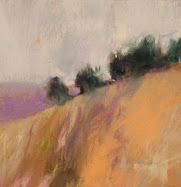
 Yellow Trees, Blue Forest
9" x 7"
Pastel
Casey Klahn
This post was originally published in 2008.
It was a great joy to receive the following question from a second grade teacher located in Mexico:
Hi. I would like to know what do you think about the idea of Rockwell of painting Pollock’s in his.
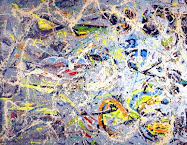
I am teaching 2nd graders about Pollock and I have found it more complex that just dripping!
My reply:
Thank you for the question.
Maybe you saw my post about an image named The Connoisseur that Norman Rockwell did of the well heeled museum patron in front of a Jackson Pollock painting.
I have a special affinity for NR, as I studied art via the Norman Rockwell Famous Artist's Course for Talented Young People when I was not much older than your second graders. He deserves the renewed interest that the art public is giving him, in my opinion.
On your question. What artist doesn't want to be liked for their artwork? Certainly there was a great deal of "artistic courage" that both of these famous artists exhibited.
NR was big enough in his heart to portray the wholly different painting style of the emerging super artist Jackson Pollock, and at the same time doing this with irony and humor. That was his trademark.
I don't see him passing any negative judgment in his painting, and as far as the art side of it is concerned, the man stands in the middle bottom of the painting, almost like a tree trunk whose canopy is the abstract painting. A wonderful idea, and difficult to pull off. Not at all following strict compositional rules. His talent in composing a painting is on show, here. That's irony, too!
JP had obvious "artistic courage" by not using regular oil paint or regular brushes or even regular primed canvases. He didn't use the easel, either. He was changing everything about painting, or as many things as he could think of to do.
As a contemporary artist, I have been given permission by JP to do more kinds of things to express my art than before he "broke" all those art rules. I choose to repeat my compositions over and over again, to make the point that the colors are the "meaning", not the trees. I like to get rid of "depth", so hammered into my brain by the great Norman Rockwell school. That reminds me (and maybe you, the viewer) that after all, you are looking at a painting about: color.
Kindly,
Casey Klahn
 Since many of us art bloggers utilize Wikipedia for our references, I thought this article would provide fair warning. The Scotsman article doesn't provide a casual link between the falling test scores of students, and the Wikipedia usage of the students, but the link seems plausible. Maybe reporters aren't what they used to be either, eh?
Catherine C. Marshall has this well written defense of the Wikipedia concept versus the dust collector style of old school encyclopedias. Some parents won't let their little redheaded girls wear red dresses. Her parents wouldn't let her use encyclopedias at the library. She reminds us to go to primary sources - you'll be the better for it.
One of the tests that I place on my own Wikipedia research is to avoid factual statements based on a Wikipedia article. I get other resources involved. Usually the beginning of further research is found in the links section at the bottom of Wiki articles.
Can you tell by the way an article in Wikipedia is written whether it bears value or not? I am more impressed with articles written with thorough content (more data) and with attributions. As a matter of fact, a grammatically well written article , with interesting content, tends to get my seal of approval.
Does the gist of the Wikipedia article agree with other articles about the subject, both in factual content and in opinion? That can reveal a big red flag if the Wikipedia is too far from the norm of broader scholarship.
Take this article on Picasso, for instance. What I notice is that it uses many links, and that the sections are very brief. Links are not attributions. The overall article is longish, but I'm not sure that I'm getting anything really meaty. Maybe it provides a starting point for those who know absolute zero about the 20th century master, but I'd be quick to find other sources here.
Now, compare the article on Leonardo da Vinci. Granted, da Vinci is the subject of more scholarship by virtue of the times he lived in and the fact that his work is a half a millenium old, rather than a half a century for Picasso. But, the point is the da Vinci article does a thorough job of covering many facets of the great master's life. After the biography comes painting, then non-painting legacy, and then it reflects upon his legendary status. Included is a list of paintings, a worthy list of footnotes and a bibliography and links round it out. There is even a pronunciation .ogg file for his name offered at the top. Looks like they missed this really nice link, though: universalleonardo.org.
Do use references in your art studies, but keep it accurate to the best of your abilities. The blogger world is reading.

Virgin and Child with the Infant John the Baptist and Saint Anne
1499-1500
Dry Media on Paper
Leonardo da Vinci
Artistic growth is a lifetime process. I recently reviewed Classic Drawing Atelier, A Contemporary Guide to Traditional Studio Practice, 2006, by Juliette Aristides of Seattle. Jen Graves, also in Seattle, has written a savvy article about the atelier, it's larger Academy of Realist Art context and the place of classicism in our contemporary art environment.
Yellow Trees, Blue Forest
9" x 7"
Pastel
Casey Klahn It was a great joy to receive the following question from a second grade teacher located in Mexico:
Hi. I would like to know what do you think about the idea of Rockwell of painting Pollock’s in his.
I am teaching 2nd graders about Pollock and I have found it more complex that just dripping!
My reply:
Thank you for the question.
Maybe you saw my post about an image named The Connoisseur that Norman Rockwell did of the well heeled museum patron in front of a Jackson Pollock painting.
I have a special affinity for NR, as I studied art via the Norman Rockwell Famous Artist's Course for Talented Young People when I was not much older than your second graders. He deserves the renewed interest that the art public is giving him, in my opinion.
On your question. What artist doesn't want to be liked for their artwork? Certainly there was a great deal of "artistic courage" that both of these famous artists exhibited.
NR was big enough in his heart to portray the wholly different painting style of the emerging super artist Jackson Pollock, and at the same time doing this with irony and humor. That was his trademark.
I don't see him passing any negative judgment in his painting, and as far as the art side of it is concerned, the man stands in the middle bottom of the painting, almost like a tree trunk whose canopy is the abstract painting. A wonderful idea, and difficult to pull off. Not at all following strict compositional rules. His talent in composing a painting is on show, here. That's irony, too!
JP had obvious "artistic courage" by not using regular oil paint or regular brushes or even regular primed canvases. He didn't use the easel, either. He was changing everything about painting, or as many things as he could think of to do.
As a contemporary artist, I have been given permission by JP to do more kinds of things to express my art than before he "broke" all those art rules. I choose to repeat my compositions over and over again, to make the point that the colors are the "meaning", not the trees. I like to get rid of "depth", so hammered into my brain by the great Norman Rockwell school. That reminds me (and maybe you, the viewer) that after all, you are looking at a painting about: color.
Kindly,
Casey Klahn
Abstract Expressionism, Art Criticism, Artists, Colorist Art, Drawing, History, Impressionism, Modern Art, Painting, Pastel, Post Impressionism

 Yellow Trees, Blue Forest











 Posts
Posts


