


All drawings, Vincent van Gogh.
Building in Eindhoven (The “Weigh House”), Neunen, Feb., 1885
Snowy Yard, The Hague, Mar., 1883
Garden in the Snow, Neunen, Feb., 1885
Oxcart in the Snow, Neunen, Aug., 1884
Old Man Drinking Coffee, The Hague, Nov., 1882
Five Men and a Child in the Snow, The Hague, March, 1883
Edge of a Wood, Etten, July, 1881
Dance Hall, Neunen, Dec 1888
I've decided to begin my van Gogh project participation by studying some of his sketches. I post a few of my favorites here.
I chose these for the good figure works, and some for the addition of Conte, or colored chalks, and others for the representation of snow. I'll be doing a few snow scenes as well. I tried to stay with graphite or charcoal works, here. One of them may be reed pen, but my sources don't say.
Before I could commit myself to this van Gogh inspired project, I had to clean up my old studio space , which is in the house. It had been half way moved out to my new 12' x 60' studio, which is a surplused house trailer. It is halfway remodeled, and sans electricity.
So, now that I am re-established in my old studio space, I am ready to go with the new works. I will begin with drawing, as it was the foundation of Vincent's work. He almost always worked from life, rather than memory or reproductions. He did do a little of the latter, especially to copy his own studies, or the etchings of other artists that he admired. He was much influenced by Jean-Francois
Millet (French, 1814-1875) and Harmenszoon van Rijn
Rembrandt (Dutch, 1606 - 1669), who were both good draftsmen.
I seldom work from life nowadays, although I have done much of it in the past. My Colorist American Landscapes are studio
works, from the imagination or removed memory. I noticed that for many of the others in this project, the van Gogh study will be a move away from realism. For, me, it will be a move toward realism.
So, I will be drawing from life, as van Gogh did. He not only didn't have the CRT or Photoshop, he really didn't even have the photograph. Photography was new in his day; it represented a challenge to the ageless pursuit of fine art, and what is more I understand that he disliked the evil photo. I share that opinion.
Anyway, I think that it will be hard for one to gain his perspective without going outside, or at least setting up a still life. I will finish the project with painting, however.
Then, also to get close to the keener's (*) motifs, I want to choose the same subjects. Sunflowers, check. Wheat fields, got 'em.. Orchards, check. Marine climate, check. Maritime subjects, check. Sunlight, check-er-rooni. Self for portraits, check.
Wish me luck!
Here are some links that I don't think I saw on blogs of other artists doing this VG project:
Unabridged Letters by or to Vincent van Gogh
http://webexhibits.org/vangogh/
Van Gogh at Etten. Interesting and broad based web site.
http://library.thinkquest.org/C001734/index.html (*) "Keener" is defined in urban slang as a nerd or eager-beaver. But, I am using it in it's old school definition of one who is keen-edged, knowledgeable; also the Irish give the keener tragic substance.


 I
I 


 Vincent et moi consultent le long des banques de la Seine.












 Posts
Posts


This is a good round up. Much thanks.
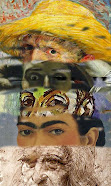
Other than some some really bad photoshopping on my part (albeit entertaining), I am attempting to recognize the long shadow of VG's person, and at the same time his oeuvre that I describe as "colorist". That's "colourist" for all you English-speakers.
I don't link his bad behavior to his earthshaking body of work. Some pretty cunning, and I think altogether preposterous theories have been put forth by absolute experts on VG.
He had a condition that made him "see" everything slightly yellow, you see.
He sucked on the end of his lead-covered brush, you know.
His condition made him super keen to produce art differently than his fore bearers.
Whatever. It doesn't pass muster with me. And I write these things to encourage my peerage in this project to try to take the "old man" with a grain of salt.
There is forgiveness, especially postmortem. Look at the parts of his work that inspire you, and follow that muse.