For a fun exercise in choosing new pastels, see the following posts at my blog, Pastel. Hue, Chroma & Value Chart, and Purple Pastel Secrets.
These posts at Pastel will be informing our Colour Project when I research the color property: Intensity.
New School Color - Casey Klahn
Too Much Sun from the West; Portable Tables, My Convertible Easel at Left, and My New Wall Easel Sitting on the Floor at Top Center.
Olive Trees & Paint

There is no straight-line relationship between the colors mixed in pigment, which will vary from medium to medium. Whereas with a psychophysical color circle, the resulting hue of any mixture of two colored light sources can be determined simply by the relative brightness and wavelength of the two lights, a similar calculation cannot be performed with two paints. As such, a painter's color wheel is indicative rather than predictive, being used to compare existing colors rather than calculate exact colors of mixtures. Because of differences relating to the medium, different color wheels may be created according to the type of paint or other medium used, and many artists develop their own individual color wheels. These will often contain only blocks of color rather than the gradation between tones which is characteristic of the color circle.The difference between the artist's pigment "color wheel" and the other color theories is best understood by the different colors anchoring them. Red, Yellow and Blue are the primaries of the pigment user because they cannot be mixed from any combination of other pigments. The science oriented, and the print maker or computer user, will identify some other set of base colors because of how light functions. I want to call that "experiential", and the pigment based paradigm I want to call "elemental".
I’m not so involved in description because I think that the greatest sin an artist can be accused of is telling people things that they already know. And you can write that down and put it in italics. Our aim as artists is to use ourselves as agents for expanding possibilities; and if you’re just doing something that’s conventional and everyday, you’re not doing it right. Of course, we constantly struggle against our own conventions because that’s one of our worst difficulties—trying to avoid doing something that we already know how to do.On the subject of Washington State Art Bloggers, I missed a local artist in my last post who is blogging and has a fascinating life story as a fourth generation artist. Kathleen Cavender.
Wolf Kahn with David Kapp and Robert Berlind

"The Americans who fought here that morning knew word of the invasion was spreading through the darkness back home. They thought--or felt in their hearts, though they couldn't know in fact, that in Georgia they were filling the churches at 4 a.m., in Kansas they were kneeling on their porches and praying, and in Philadelphia they were ringing the Liberty Bell."
President Ronald Reagan.


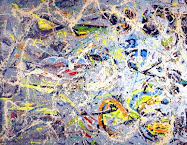
Tobey won international acclaim for his work towards the end of his life. He became the first American since James Abbot Whistler (1834-1903) to win the Painting Prize at the Venice Biennale, an award he won in 1959. In 1961, he had a retrospective showing at the Louvre in Paris, an extraordinary tribute to the work of a living artist. These landmark achievements were followed by a major exhibition at the New York Museum of Modern Art in 1962 and, in 1974, another major show at the National Collection of Fine Arts in Washington, which is part of the Smithsonian Institution.
Art critics and historians in the United States have long been uncertain exactly how to categorize Tobey. Many gave Pollock most of the credit for creating the all-over style. Others have suggested that Tobey's internationalism and even his religion have so far kept him from being accepted in mainstream art circles.